
Five at the back, three in the middle, two up front. The 5-3-2 shuts the door — and waits for the moment the opponent opens up.
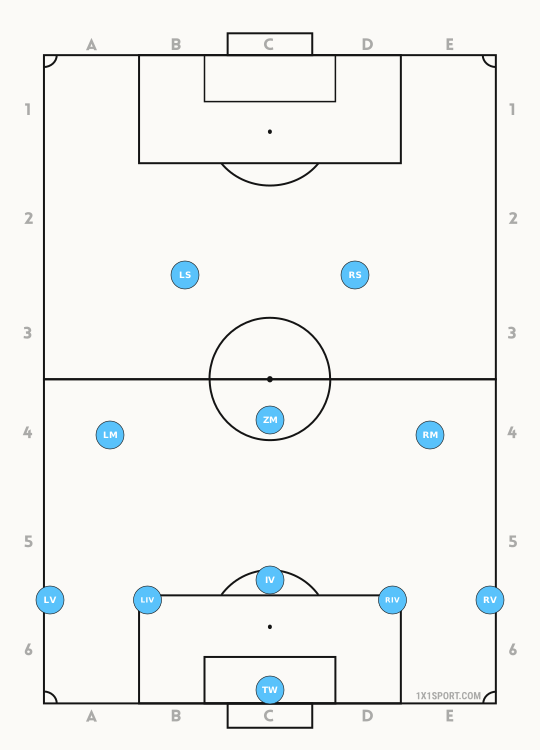
Positions & Roles
- GK – Goalkeeper: Organizes the back five from behind. Must master one-on-ones because opponents appear quickly when breaking through.
- CB – Three center-backs: Form the center of the back five. The middle CB directs, the half-backs cover half-spaces and push wide when needed. Group-tactical shifting in the line is the key.
- FB – Two fullbacks: Stay deep and cover the flanks. Unlike wingbacks, they only push forward in possession with a clear space advantage.
- CM – Three midfielders: Work as a compact block in front of the back five. One six covers, the eights shift toward the ball and support on counters.
- ST – Two strikers: The counter-attacking weapon. Stay high, wait for long balls or quick vertical passes. One goes deep, one comes short to initiate the counter.
Overview
The 5-3-2 is the system of controlled defense. Five defenders form a wide chain covering the entire penalty area. Three midfielders pack the center. And two strikers wait for the right moment to counter. The difference from the 3-5-2 isn't just a number — it's a philosophy. In the 3-5-2, wingbacks are offensive. In the 5-3-2, the fullbacks stay deep. The back five holds, the fullbacks defend, and attacks come only through counters or set pieces. Sounds destructive? Maybe. But it wins games that shouldn't be winnable. Covering defense is never a problem here — five players stay back almost always.
Game Idea & Core Principles
When the opponent has the ball, the back five sits deep, the midfield shifts compactly toward the ball. Two strikers stay high and only passively disrupt the build-up. On winning the ball, it's fast: long ball to the strikers or quick vertical pass through the center. Fullbacks stay relatively deep even in own possession — offense comes from the center.
Strengths
- Maximum defense: Five defenders plus three midfielders put eight men behind the ball. The center and half-spaces are packed.
- Back five absorbs pressure: Even against strong opponents with lots of possession, the back five holds — there's always a free defender.
- Counters with two strikers: While the opponent attacks, two strikers stay high. A quick vertical pass can instantly become a chance.
- Psychologically stable: The team knows: we're safe at the back. This confidence provides stability even in difficult phases.
- Set pieces as a weapon: On corners and free kicks, aerially strong center-backs get chances to push forward.
Weaknesses
- Offensively limited: Without advancing fullbacks, there's no width in attack. The two strikers are often on their own.
- Midfield numerically inferior: Three midfielders against four or five opponents means less possession and less control.
- Invites sustained pressure: Standing this deep invites the opponent to build pressure. Over 90 minutes, this becomes mentally and physically wearing.
- Needs disciplined players: Everyone must hold their position. One player breaking ranks tears a gap that five defenders can't always close.
- Hard to transition: From a deep block to a quick counter is a long way — defensive tactics must be drilled so there's no panic in transition moments.
Variants & Transitions
Notable Examples
When to Use & Requirements
For underdogs looking to survive against superior opponents. For teams needing to protect a lead. Or for squads without offensive fullbacks who make defense their strength.
Tips for Club Coaches
Practice shifting the back five as a unit: all five must shift toward the ball simultaneously without gaps opening. Train the transition moment after winning the ball: the first pass must be accurate because the strikers only have a few seconds' advantage before the opponent reorganizes. Set pieces are your best friend — invest training time in corners and free kicks.
Frequently Asked Questions about the 5-3-2
What's the difference between 5-3-2 and 3-5-2?
In the 3-5-2, wingbacks push forward offensively and only form a back five without the ball. In the 5-3-2, fullbacks fundamentally stay deep — the back five is permanent. The 3-5-2 is more offensive, the 5-3-2 more defensive.
Is the 5-3-2 Catenaccio?
It shares Catenaccio elements — deep defending, counter-attacks, result protection. But a modern 5-3-2 presses higher than classic Catenaccio and uses three midfielders rather than a pure man-marking system.
Who is the 5-3-2 suited for?
For underdogs against superior opponents, for teams protecting a lead, and for squads with strong center-backs but weak fullbacks.
How do you attack in the 5-3-2?
Primarily through counters: on winning the ball, quick vertical pass to the strikers. Secondarily through set pieces: corners and free kicks with aerially strong defenders.
Can you play the 5-3-2 in youth football?
It's possible but not ideal for player development. Young players should learn to create, not just defend and counter. From U17, it can be useful as a tactical variant.
Edit in Taktikapp
Click the button to open the 5-3-2 formation directly in Taktikapp. There you can move player positions, draw movement arrows, and adapt the tactics to your needs.
Open in Taktikapp