
The right system for your team — football formations
Every system at a glance — strengths, weaknesses and who it suits. Pick one and set it up directly on the board, free.
Invite-only beta — join the waitlist, your invite code usually arrives within a few hours.

What do the numbers in a formation mean?
4-4-2, 4-3-3, 3-5-2 — everyone talks about them. But which one fits your squad? And what do the numbers even mean?
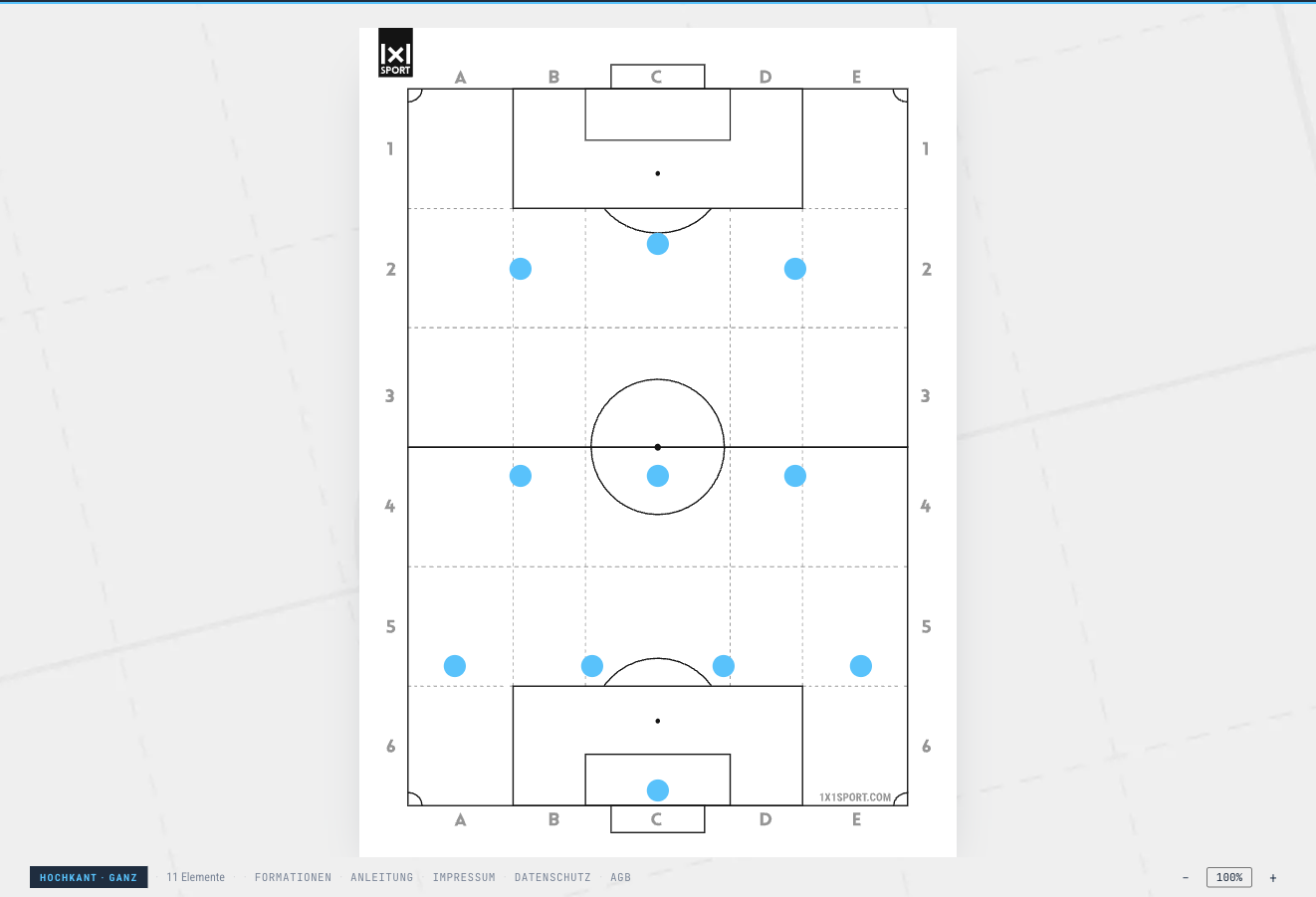
A formation — also called a shape or system — describes how your team lines up before the ball rolls. You read the numbers from back to front: defence, midfield, attack. The goalkeeper is never counted.
So a 4-3-3 means: four defenders, three midfielders, three forwards. A 3-5-2: three center-backs, five in midfield (including the wing-backs out wide), two strikers. More numbers mean more lines — a 4-2-3-1 splits the midfield into a double pivot and a line of three behind the lone striker.
Everything else follows from this base shape: who presses, who covers, where the overloads appear and where the gaps open up.

All formations at a glance
19 systems as clickable boards — pick one, read its strengths and weaknesses on the formation page and set it up directly on the board.
Formations with a back four


Formations with a back three & back five


Every formation page explains positions, game idea, strengths, weaknesses and gives practical tips — and from there you open the system on the board with one click. The individual pages go deep, this overview helps you choose.
Which formation fits your team?
It's not the formation that makes the game, but how well it fits your players. Four simple rules of thumb — the rest you try out on the board.
Technically strong → possession
If your team can combine and keep the ball, give it triangles and width: 4-3-3 or 4-2-3-1 with a ten between the lines.
High-stamina & robust → pressing
If your team loves to run, press high: the classic 4-4-2 with two clear lines of four is easy to shift and ideal for closing down.
Shaky at the back → back five
If you concede too easily, a back three or five stabilises things: 5-3-2 or 3-5-2 give security at the back and two strikers up front.
Youth & small pitches → simple
For kids, clarity counts: clear spaces, few lines. Set the formation up on the board for the right pitch size and show it as an image — everyone sees their position.
The honest truth: there is no single best formation. The best one is the one that fits your players — not the one a top club happens to be playing. That's exactly what the board is for: set up two or three systems in five minutes, compare them side by side, decide.
Strengths and weaknesses of the most common systems
The four systems you see most often — briefly to the point. The full depth is on each formation page.
4-4-2 — the classic
- Simple, clear positions, ideal for beginners & youth
- Compact off the ball, easy to shift
- Quickly outnumbered centrally against midfield threes
4-3-3 — width & pressing
- Width through the wings, good pressing angles
- Triangles for combination play
- Demands high-stamina, press-resistant eights
4-2-3-1 — the standard
- Double pivot covers, ten between the lines
- Flexible between control and counter
- The lone striker can get isolated
3-5-2 — overload in the center
- Three center-backs, wing-backs for width
- Two strikers, numbers in central midfield
- Lives and dies with the fitness of the wing-backs
You don't have to commit before you've seen it: open two of these systems on the board, put your real players in and see which one feels right.
Modern and defensive systems
Today, the modern systems are above all the 4-2-3-1 and possession-based variants of the 4-3-3: they occupy the half-spaces, look for the ten between the lines and press immediately after losing the ball. Lots of movement, clear roles, high ball control.
If you need defensive stability — against a stronger opponent or to see out a lead — back fives like 5-3-2 and 5-4-1 provide security: a compact defensive block, few spaces, safe rest defence. The price is less possession of your own and a longer route forward.
The trick isn't to play "the most modern" system, but the one that fits the task — and often to switch within a match. You can rehearse that on the board too: the same team in two shapes, one click between them.
Formation chosen? Now set it up and share
From the overview into the real board: you open your formation, move the players to their positions, add names or numbers and draw the first runs if you like. The base shape becomes your concrete lineup.
Then you share it as a PNG image in the team group or via link with the coaching staff — so before the game everyone knows where they stand. (A PDF export isn't available yet.)
Frequently asked questions about football formations
What do the numbers in football formations mean?
You read the numbers from back to front: 4-3-3 means four defenders, three midfielders, three forwards. The goalkeeper is never counted. This base shape determines runs, pressing behaviour and attacking structures.
Which formation fits my team?
Rule of thumb: technically strong teams play possession-based (e.g. 4-3-3 or 4-2-3-1), high-stamina teams press (e.g. 4-4-2), teams shaky at the back stabilise with a back five (e.g. 5-3-2). Best of all, try two or three systems directly on the board.
What is the best formation in football?
There isn't one. Every system has strengths and weaknesses. The best formation is the one that fits your players — not the one a top club happens to be playing. The 4-4-2 is seen as the simplest entry system, the 4-2-3-1 as the most widely used.
Which formations are there?
You'll find 19 systems here — from classics like 4-4-2 and 4-3-3 through the modern 4-2-3-1 to back threes and back fives like 3-5-2, 3-4-3 or 5-3-2. Each with its own page, strengths, weaknesses and a board to set it up yourself.
Can I set up a formation myself?
Yes. You open every formation directly on the board, move the players to your positions and share the result as a PNG image or via link. Free, in the browser. The app is currently in invite-only beta — join the waitlist and your invite code usually arrives within a few hours.
What is the difference between a back four, back three and back five?
The back four (e.g. 4-4-2) uses four defenders with two fullbacks and is stable on the flanks. The back three (e.g. 3-5-2) relies on three center-backs plus wing-backs and creates a numerical advantage in the center. When possession is lost, a back three often becomes a back five (5-3-2) defending deep.
Which formation for youth football or small-sided pitches?
On small pitches, simple and clear wins — a flat structure with unambiguous spaces so kids understand their position. On the board you set the formation up for the relevant pitch size and show it to your team as an image.
Want not just the formation, but to understand how you attack and defend with it? The 1x1SPORT academy delivers the tactical content behind the systems.
Set up a formation on the boardCurrently in invite-only beta — join the waitlist and your invite code usually arrives within a few hours.