
4-3-1-2 Formation: Setup, Strengths & Weaknesses
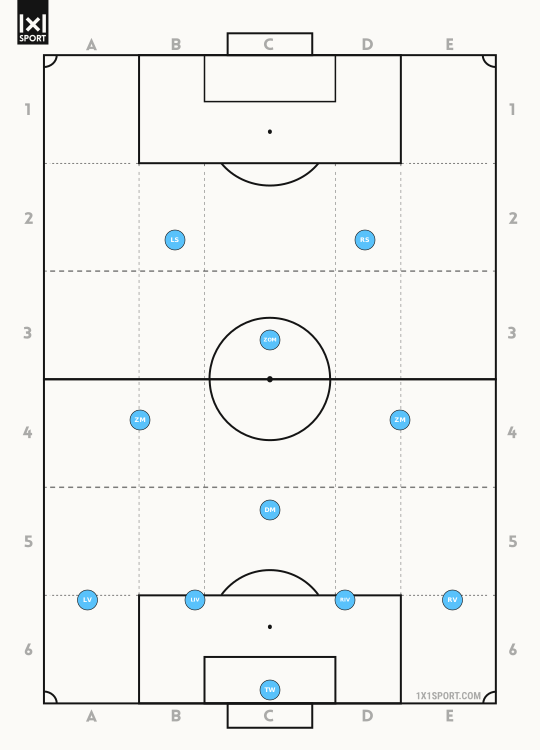
Four at the back, three in midfield, a number ten, two strikers. The 4-3-1-2 bundles everything in the center: where other systems have wingers, this one has a playmaker and a strike partnership.
Positions explained · Strengths & weaknesses · Set up on the board · Share as PNG
Start for free: enter your email, click the login link, go.
Positions & Roles
- GK – Goalkeeper: Plays behind a back four whose full-backs often push high. He has to sweep up long balls into the space behind them.
- CB – Two center-backs: Protect the center and start the build-up. When the full-backs push forward they have to spread wider.
- LB/RB – Full-backs: The only players who provide width all the time. They push high in possession and need the engine for many sprints along the whole flank.
- DM – Holding midfielder: Sits centrally in front of the defense, distributes the ball and closes gaps when the eights go forward.
- CM – Two eights: Shuttle between half-space and flank. They support the full-backs and arrive late in the box.
- AM – Number ten: The playmaker between the lines. Looks for gaps between the opposing midfield and defense and feeds the two strikers.
- ST – Two strikers: Work as a pair. One runs in behind, the other drops or drifts wide.
Overview
The 4-3-1-2 is a formation with a back four, a three-man midfield, a number ten behind the strikers and two forwards. There are no traditional wingers. Width comes mainly from the full-backs.
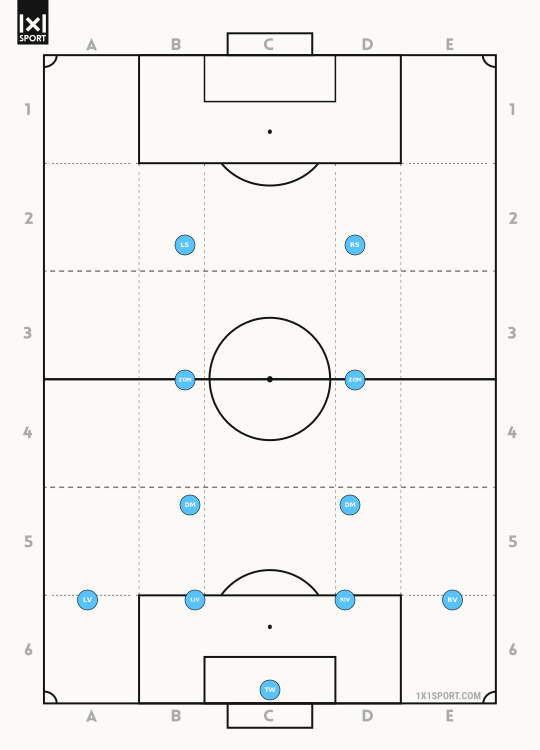
It is closely related to the 4-4-2 diamond. The difference is in midfield: the terms are often used interchangeably. We distinguish them like this: in the diamond the holding midfielder sits clearly deeper than the two eights. In the 4-3-1-2 the three midfielders form a flatter, more compact line in front of the back four.
It is known, among others, from Italian football, for example Juventus under Massimiliano Allegri. It lives on a strong number ten who distributes the ball between the lines and on two strikers who share the work.
Game Idea & Principles
The 4-3-1-2 looks for an overload in the center. With a holding midfielder, two eights and a ten there are four players in the middle – against a flat 4-4-2 with two central midfielders that is two more than the opponent.
In possession the full-backs push high and provide width. The eights move into the half-spaces, the ten finds space between the lines, the two strikers pin the center-backs. Play goes mainly through the middle.
Against the ball the team stays narrow. The strikers press the center-backs, the ten can pick up the opposing holding midfielder. The eights shift towards the ball so the full-backs are not left alone against two.
Strengths and Weaknesses
Strengths
- Overload in the center — Four central players against usually two or three. Short passing and ball control become easier.
- A real playmaker — The ten has a fixed role between the lines where creative players can shine.
- Strike partnership — Two strikers occupy both center-backs and can open space for each other.
- Compact in front of the defense — The flat three-man midfield can screen the space in front of the center-backs well.
Weaknesses
- No wingers — Width depends on the full-backs alone. If they stay deep, play becomes narrow and predictable.
- Vulnerable on the flanks — Against teams with two wingers and overlapping full-backs you are quickly outnumbered out wide.
- Heavy load on the eights — They have to help inside and cover outside. Without a lot of running a gap opens.
- Dependent on the ten — If the playmaker is missing or tightly marked, the link to the strikers is gone.
Variants & Transitions
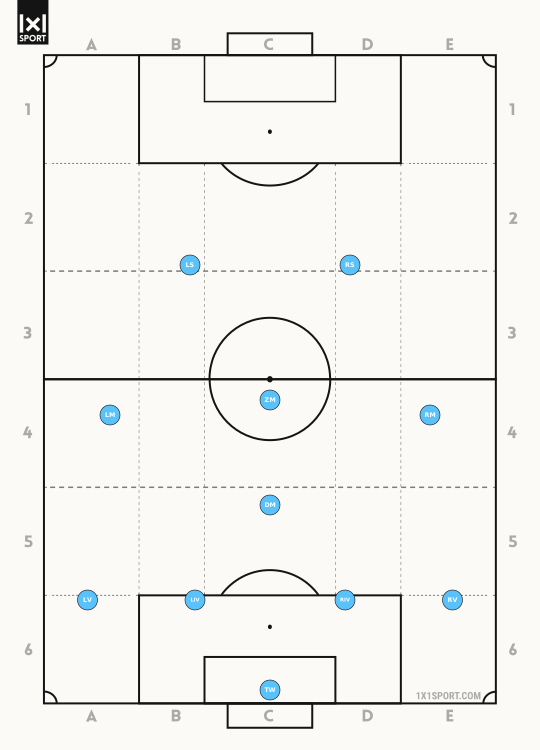
4-3-1-2 → 4-4-2 diamond: The eights move wider and the holding midfielder stands alone. The eights play higher and the holding midfielder defends the space in front of the back line alone.
4-3-1-2 → 4-3-3: The ten becomes a third forward and the strikers drift wide. This gives the team the width it is missing.
4-3-1-2 → 4-1-3-2: The ten drops level with the eights. A line of three in front of the holding midfielder, more presence in the half-spaces.
4-3-1-2 → 3-1-4-2: A third center-back replaces the number ten and the full-backs become wingbacks. More cover at the back, width along the full length of the flank.
Notable Examples
Massimiliano Allegri — Juventus (2014/15): In the Champions League Allegri used a 4-3-1-2 with Arturo Vidal as the number ten behind Carlos Tévez and Álvaro Morata. Juventus won the first leg of the semi-final against Real Madrid 2-1, with Morata and Tévez scoring, and reached the final. Some analyses describe the shape as a 4-1-3-2 – in both readings Vidal played as an attacking midfielder behind the strikers with a lot of work without the ball.
Where It Fits & Requirements
The 4-3-1-2 suits teams with a creative number ten, two strikers who complement each other and full-backs with stamina. Without good full-backs the width is missing. It can be coached well from U14/U15, because the back four stays familiar and only midfield is built differently.
Tips for Grassroots Coaches
Train the full-backs as width providers: in possession they belong on the touchline, as high as the situation allows. Otherwise play through the middle becomes too congested.
The eights have to shift outside when the ball is on the flank. Practice this in a 6 v 6 game on a wide pitch where the opponent has wingers.
Give the ten freedom, but also a job without the ball: a proven option is for him to pick up the opposing holding midfielder. That helps keep the center closed when the opponent builds up.
Frequently asked questions about the 4-3-1-2
What is the difference between the 4-3-1-2 and the 4-4-2 diamond?
The players are the same and the terms are often used interchangeably. We distinguish them like this: in the diamond the holding midfielder sits clearly deeper than the eights. In the 4-3-1-2 the three midfielders form a flatter, narrow line in front of the defense.
Who provides the width in the 4-3-1-2?
The full-backs. There are no wingers, so they have to be high and wide in possession. The eights help out now and then.
Which systems is the 4-3-1-2 strong against?
Against systems with two central midfielders, such as the 4-4-2. There the 4-3-1-2 has a clear overload in the center.
From what age can you play the 4-3-1-2?
From U14/U15. The back four stays as usual, but the midfield roles need some tactical understanding.
What is the role of the number ten in the 4-3-1-2?
He is the playmaker between the lines. He links midfield and the two strikers and can pick up the opposing holding midfielder without the ball.
Similar Formations
Formation set — now to the concrete lineup or the set plays. The 1x1SPORT academy delivers the tactics behind the systems.
Set up the 4-3-1-2 on the boardStart for free: enter your email, click the login link, go.