
4-4-1-1 Formation: Setup, Strengths & Weaknesses
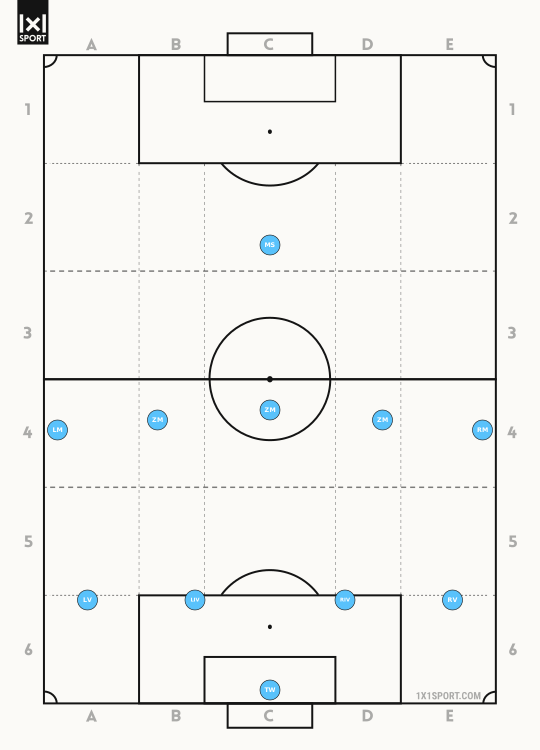
Two banks of four, one striker up top and one just behind. The 4-4-1-1 is the 4-4-2 with one difference that matters a lot: the second striker plays a little deeper and links midfield and attack.
Positions explained · Strengths & weaknesses · Set up on the board · Share as PNG
Start for free: enter your email, click the login link, go.
Positions & Roles
- GK – Goalkeeper: Plays behind two compact banks of four. He starts the build-up and organizes the back line.
- CB – Two center-backs: Form a back four with the full-backs that shifts as a unit. They have to communicate closely with the central midfielders.
- LB/RB – Full-backs: Protect the flank and push up in possession to support the wide midfielders.
- LM/RM – Wide midfielders: Help defend the flank and provide width and crosses in attack.
- CM – Two central midfielders: One covers, one drives forward. They hold the middle together and link up with the second striker.
- SS – Second striker: Plays between the lines, finds the ball in front of the defense, creates chances and also gets shots away.
- ST – Center-forward: The furthest player forward. Pins the center-backs, runs in behind and creates space for the second striker.
Overview
The 4-4-1-1 is a formation with a back four, a flat four-man midfield, a second striker and a center-forward. It is a close relative of the 4-4-2: the same players, but one of the two strikers drops between the lines.
This second striker is the heart of the system. He is half number ten, half forward. In possession he collects the ball in the space in front of the opposing defense, without the ball he marks the opposing holding midfielder.
The 4-4-1-1 combines the organisation of the 4-4-2 with more connection in the center. Many teams that officially play a 4-4-2 actually line up in a 4-4-1-1.
Game Idea & Principles
Against the ball the 4-4-1-1 sets up in two banks of four that shift towards the ball. The second striker picks up the opposing holding midfielder, the center-forward presses the center-backs. That makes it hard for the opponent to build through the middle.
In possession the second striker becomes the key passing option. He shows between the lines, turns and feeds the center-forward or the wide players. The full-backs push up to create overloads on the flanks.
The roles are clear, which makes it easier to learn. At the same time it is flexible: one movement of the second striker turns it into a 4-4-2 or a 4-5-1.
Strengths and Weaknesses
Strengths
- Clear structure — Two banks of four give every player a fixed place. The system is easy to explain.
- Link between the lines — The second striker closes the gap that opens between midfield and attack in a flat 4-4-2.
- Solid without the ball — With the second striker marking the holding midfielder, the opponent struggles to play through the center.
- Flexible — Depending on the score, the 4-4-1-1 quickly becomes a 4-4-2 or a 4-5-1.
Weaknesses
- Center-forward often isolated — When the second striker drops deep, only one player is left against two center-backs.
- Dependent on one key player — Without a good second striker the system is little more than a 4-4-2 with a gap.
- Outnumbered against three central midfielders — Against a 4-3-3 two central midfielders face three. The second striker then has to do a lot of defensive work.
- Limited attacking options — Often only two players are up front. Without overlapping full-backs and brave wide midfielders there are few targets in the box.
Variants & Transitions
4-4-1-1 → 4-4-2: The second striker moves up alongside the center-forward. More pressure on the opposing center-backs.
4-4-1-1 → 4-5-1: The second striker drops into midfield. Five in the middle, ideal for protecting a lead.
4-4-1-1 → 4-2-3-1: The wide midfielders push up level with the second striker. More attacking power, more players between the lines.
Notable Examples
Arsène Wenger — Arsenal (2003/04): The “Invincibles” went a whole Premier League season unbeaten. Nominally Arsenal played a 4-4-2 with Robert Pires and Fredrik Ljungberg out wide. But Dennis Bergkamp often did not play level with Thierry Henry – he operated deeper, in the space between the opposing midfield and defense. That matches the picture of a 4-4-1-1.
Where It Fits & Requirements
The 4-4-1-1 suits teams that need a clear structure and have a player who is good between the lines. You need a well-drilled back four, two hard-working wide midfielders and a center-forward who can hold his own up front alone. As an eleven-a-side formation it fits from U14/U15, when teams play eleven against eleven on a full pitch. The basic shape matches the 4-4-2, so it is easy to teach.
Tips for Grassroots Coaches
Give the second striker a clear job without the ball, for example marking the opposing holding midfielder. That makes it harder for the opponent to play through the middle.
Train the interplay of the two strikers: when the center-forward runs in behind, the second striker shows in the space he leaves – and vice versa.
Practice the shifting of the two banks of four first without opponents, then in a 9 v 9 game (two banks of four plus goalkeeper). A distance of about 10–15 meters between the lines is a good guide.
Frequently asked questions about the 4-4-1-1
What is the difference between the 4-4-1-1 and the 4-4-2?
In the 4-4-2 the strikers basically start on the same line, even if they stagger during play. In the 4-4-1-1 one of them consistently plays deeper, as a second striker between the lines. That creates more connection to midfield.
What does the second striker do in the 4-4-1-1?
He is half number ten, half forward. In possession he shows between the lines and creates chances, without the ball he marks the opposing holding midfielder.
Is the 4-4-1-1 a defensive system?
It is rather balanced. Without the ball there are two compact banks of four, in possession the team has two players up front and two wide players.
From what age can you play the 4-4-1-1?
As an eleven-a-side formation from U14/U15, because in German youth football U12/U13 play small-sided (up to 9 v 9). The basic shape matches the 4-4-2; only the second striker's role is new.
How does the 4-4-1-1 become a 4-5-1?
The second striker drops back level with midfield. Then there are five players in the middle and one striker up front – typical when protecting a lead.
Formation set — now to the concrete lineup or the set plays. The 1x1SPORT academy delivers the tactics behind the systems.
Set up the 4-4-1-1 on the boardStart for free: enter your email, click the login link, go.